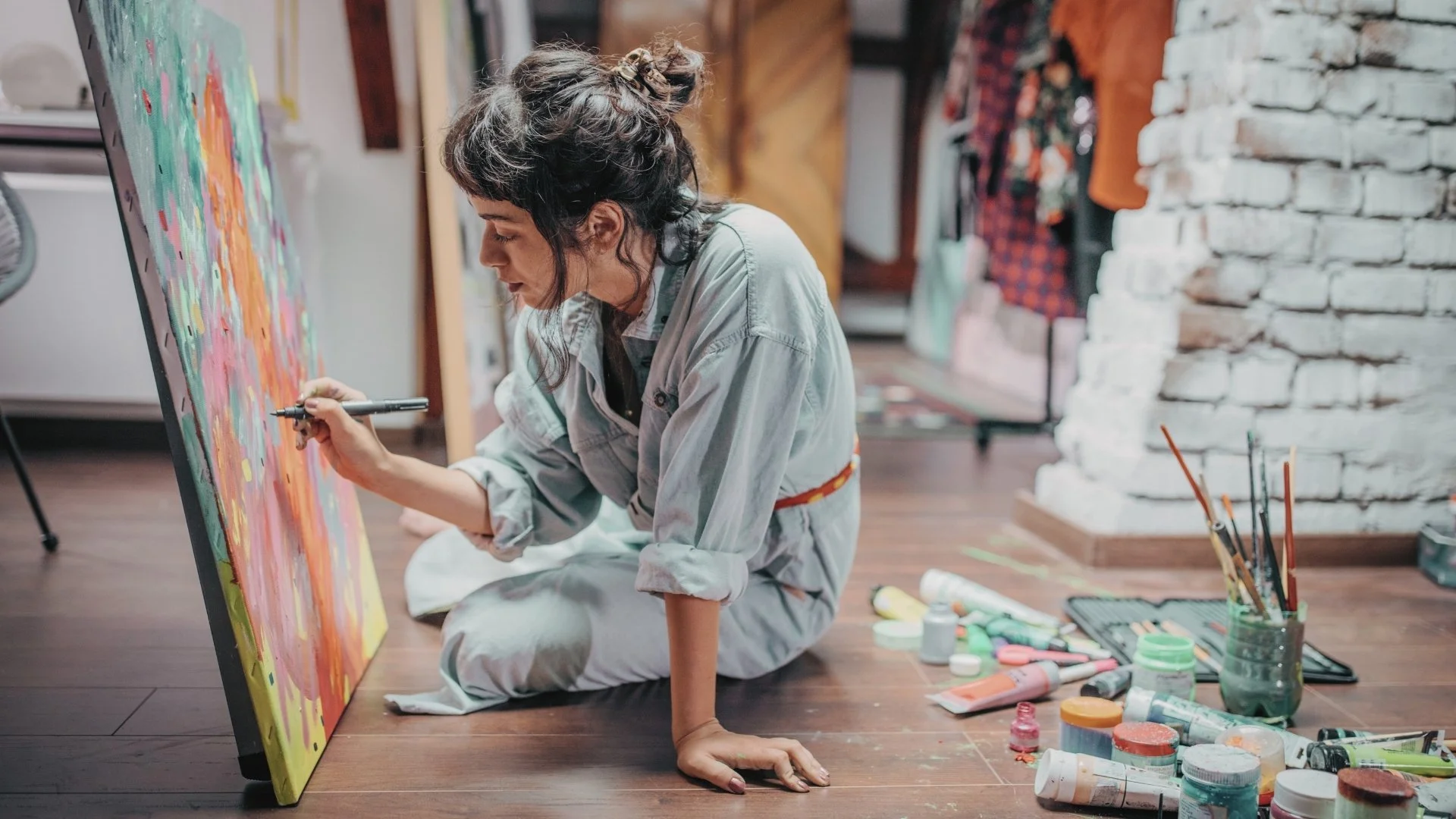
Supporting YOUTH Development Through Artistic Exploration
Often, when we talk about positive youth development, we think of academic achievement, social development, and overall health and wellbeing. Artistic expression may not immediately come to mind. Many of us – incorrectly! – assume that opportunities to explore the arts are a bonus, just one of many hobbies or extracurricular activities our children can engage in. However, that couldn’t be further from the truth!
The Arts Matter for Youth Development
Both research and lived experience support that regular, meaningful opportunities to engage in arts activities and artistic expression support global development for children, youth, and young adults of all backgrounds and lived experiences.
The arts support academic success
Engaging in both structured and unstructured arts activities is shown to support problem-solving and critical-thinking skills by providing opportunities for young people to make observations about the world around them, make decisions, adapt to mistakes, improve focus and attention to activities, and develop frustration tolerance over time. Arts activities also support the development of fine motor skills (using hands and fingers) and gross motor skills (larger body movements) that form the foundations of many of the skills kids use in school.
The arts support social development
The arts provide opportunities for social interaction in a lower-pressure or less-direct format, especially for young people who find social situations or forming peer relationships challenging. Engaging in arts activities together can create shared experiences that help to form meaningful connections. Creative activities can also serve as a social buffer, making quiet moments between peers feel less awkward and keeping brains and bodies engaged to reduce anxiety or stress when interacting with others.
The arts support emotional wellbeing
Many young people have a difficult time naming and talking about their emotions. Artistic expression creates opportunities to let big, complex feelings and ideas out without having to talk about them directly. It also helps to build confidence and a sense of mastery as artistic skill improves with time and practice. This enhanced self-efficacy helps young people build resilience and a belief that they can achieve their goals.
An Arts-Rich Home
Looking for ways to foster artistic exploration for your child or teen at home? Use the suggestions below as a starting point – and see where your young person’s journey leads.
Simple swaps. Many of our homes have some kind of media as the background noise to our day. Making a simple swap, such as turning off the TV and playing music from a favorite artist instead, can start to set the tone for an arts-rich home environment for ourselves and our young family members. Talk about what you’re listening to and why you chose it – does the music bring back a particular memory or create an emotional experience? Invite family members to share a song or two as well – and talk about why they picked it. Getting to know one another’s musical tastes and exploring how we express ourselves through music can be a simple place to start.
Create together.Make time as part of your regular routines to create together. Even if you’re not working on the same project or activity, spending time being creative alongside the other members of your family builds connection and opportunities for communication without the pressure of a face-to-face conversation. Draw, journal, have a dance party, decorate cookies, or sculpt with play-doh – there are so many ways to be creative together.
Home art station. Sometimes, just making the materials available to our young family members is enough to encourage natural curiosity and creativity. Choose a space in your home to store crayons, markers, paper, stickers, and other materials within easy reach. Think outside of the box a bit, too – common household items like empty cereal boxes or paper towel roll tubes can become an opportunity for artistic exploration.
Processes over outcomes. Any time you and your young ones are being creative, model a focus on processes over outcomes. Art should be enjoyed – the process should feel regulating, expressive, and fun, regardless of how it turns out in the end. When your child shows you what they’ve created, praise their efforts more than the results. Ask questions about how it felt to be creative, what they liked about the process and what was challenging.
An Arts-Rich Community
The Heart of Texas has a longstanding and rich arts community – from visual arts to theater, from music to dance, there are so many opportunities for children, youth, young adults, and families to explore artistic expression. The list below highlights several – but not all! – of the many ways to get plugged in to the art community in our backyard.
Art Center Waco. Art Center Waco is a local arts nonprofit offering a variety of programming from art exhibitions and artist talks to classes for children, youth, and adults. Learn more about Art Center Waco’s programming at https://artcenterwaco.org/.
Bosque Arts Center. Bosque Arts Center is the longstanding fine arts hub of Bosque County. Located in Clifton, the nonprofit hosts art exhibitions, performances, conferences, classes, camps, and more. Learn more about Bosque Arts Center’s programming at https://www.bosqueartscenter.org/.
Waco Civic Theatre. Waco Civic Theatre is a local performing arts nonprofit offering opportunities for performing arts education and participation in live theatre productions. Learn more about Waco Civic Theatre’s programming at https://wacocivictheatre.com/.
Waco Symphony. The Waco Symphony is a local nonprofit whose mission is to present symphonic music that will inspire, engage, and enrich the cultural life of our community. Waco Symphony offers live performances and music education opportunities for children, youth, young adults, and fa
Art Matters
The arts are so much more than an extracurricular activity. Opportunities for artistic exploration support academic success, social development, and emotional wellbeing for children, youth, and young adults. Finding simple, routine ways to foster an arts-rich home environment and get involved in the arts in the community are great ways to support your young person and their overall wellbeing and success!
Continued Exploration
Want to learn more about how opportunities for artistic expression support positive youth development? Check out these additional resources online!
Why Art Is Important for Kids – The Role of Art Education in Child Development (Article) | Miami Children’s Museum
Special Report: Troubled Youth & the Power of Expressive Painting (Article) | Art & Creativity for Healing
Educating Ourselves about Childhood Arts Experiences – and Why They Matter (Article) | National Endowment for the Arts